Employees no longer access business systems from one office, one network or even one type of device. A normal working day might involve a laptop, email, cloud applications, customer platforms, internal systems and privileged tools, all connected through the same user identity.
That flexibility creates an important security challenge. Protecting the account without considering the device leaves one part of the access path exposed, while hardening the endpoint provides limited protection if the user behind it has excessive privileges or weak authentication.
Identity and endpoint security brings those two areas together. It protects who is requesting access, the device being used, the privileges available and the controls that determine what happens after access is granted.
NIST Zero Trust Architecture reflects this relationship by stating that trust should not be granted simply because a user or device sits inside a corporate network. Authentication and authorisation of both the subject and the device should occur before access to enterprise resources is established.
What Is Identity and Endpoint Security and Why Does It Matter?
Identity security controls who users and systems claim to be, how that identity is authenticated and what access it receives. Endpoint security protects the laptops, desktops, workstations, mobile devices and other systems through which those identities interact with the business.
These two areas increasingly depend on one another. A strong password and MFA can protect an account during login, but an already compromised endpoint may expose browser sessions, authentication tokens or privileged credentials after successful authentication. Conversely, a hardened laptop cannot prevent misuse if the employee account has unnecessary access to sensitive systems.
The NCSC’s identity and access management guidance specifically recommends considering the trustworthiness of the device from which authentication takes place. It also advises organisations to avoid performing privileged activity from untrusted devices because the potential impact increases as access becomes more sensitive.
A mature security programme therefore needs to answer several questions together. Who is requesting access? How strongly have they authenticated? Is the endpoint known and appropriately protected? What privileges does the identity possess? Which systems should that combination of user and device actually be allowed to reach?
Businesses that need structured support across these areas can use Aegixis Identity & Endpoint Security Services to strengthen endpoint hardening, privileged access, least privilege, EDR effectiveness and endpoint privilege management as part of one connected security strategy.
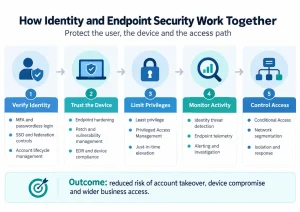
How Identity and Endpoint Security Protect Users, Devices and Business Access
Effective identity and endpoint security creates several layers between an attacker and the systems they ultimately want to reach. No single control can be expected to stop every attack, so each layer should reduce the opportunities available when another one fails.
1. Strong Authentication Protects Business Identities
Identity security begins by establishing that an account represents the correct person, service or system, then applying authentication appropriate to the sensitivity of the requested access.
Passwords alone provide limited assurance because they can be phished, reused, guessed or stolen. MFA adds another layer, although different MFA methods provide different levels of resistance to attack.
CISA recommends MFA across important business systems and advises organisations to move towards phishing-resistant authentication where possible. Administrative accounts, remote access, email and systems containing sensitive information deserve particular attention because compromise of those identities can provide substantial access.
Modern identity security therefore extends beyond enforcing longer passwords. Authentication strength, account recovery, federation, session handling and the consistency of controls across different services all affect whether an attacker can successfully impersonate a legitimate user.
NIST SP 800-63-4, finalised in 2025, reflects this wider model by covering identity proofing, authentication, authenticator management and federation as connected parts of digital identity.
Email also plays an important role because many account takeover attempts begin with phishing, malicious attachments or fraudulent login pages. A structured email security assessment can help determine whether domain protection, mailbox security and authentication controls reduce those routes into the identity environment.
2. Endpoint Security Determines Whether the Device Can Be Trusted
A legitimate user does not automatically make the device trustworthy. Malware, missing patches, weak configuration or excessive local privileges can turn a genuine employee laptop into an attacker-controlled access point.
Endpoint security therefore needs to consider the operating system, installed applications, security configuration, patch status, local permissions, firewall rules, encryption and EDR coverage. Managed devices should remain visible throughout their lifecycle so security teams can identify systems that stop receiving policies, updates or monitoring.
For example, an employee could successfully complete MFA from a compromised workstation. If malware already controls the endpoint, the attacker may attempt to abuse the authenticated session rather than defeat MFA again.
That distinction explains why device security should be considered part of the access decision rather than something that matters only after login. A deeper endpoint security assessment can examine hardening, vulnerable software, privilege escalation, credential exposure and defensive-control effectiveness across business devices.
3. Least Privilege Limits What Successful Access Can Reach
Authentication answers whether the organisation believes a user is who they claim to be. Authorisation determines what that user can do afterwards, and this distinction becomes critical once an account or endpoint is compromised.
Least privilege reduces exposure by giving users, applications and services only the permissions required for their role. A finance employee might need access to accounting systems but not server administration, while a developer may require selected cloud permissions without unrestricted control over the entire environment.
The NCSC recommends assigning privileges according to role and separating routine user activity from privileged administration. Permanent administrator rights on endpoints deserve similar scrutiny because malware or a compromised account can inherit more capability when the user is already highly privileged.
Endpoint privilege management can provide temporary or approved elevation without leaving employees permanently privileged. Broader Privileged Access Management can then protect high-risk administrator identities, credentials and sensitive administrative workflows.
Where Microsoft identity services control access across much of the organisation, Active Directory and identity VAPT can reveal hidden privilege relationships, unsafe delegation, service-account exposure and routes towards higher levels of control.
4. Trusted Administration Needs Trusted Devices
Privileged users create a different level of risk because their accounts can modify security controls, access sensitive information and administer critical systems. The endpoint used for that work therefore matters almost as much as the account itself.
An administrator who signs into production systems from the same laptop used for normal email, browsing and everyday work exposes privileged access to a much larger attack surface. A malicious attachment or compromised browser session can potentially affect credentials that should have remained protected.
The NCSC’s guidance on secure administration and trusted management devices recommends using trusted devices for high-risk administration and discusses dedicated Privileged Access Workstations where the potential impact justifies them.
This does not mean every small business requires a separate workstation for every administrator. It does mean that the sensitivity of an account should influence the security requirements of the device from which that account can be used.
5. Identity and Endpoint Monitoring Detect What Prevention Misses
Preventative controls reduce risk but cannot guarantee that every malicious login, compromised device or unsafe action will be blocked. Monitoring provides the next opportunity to identify activity before it develops into a larger incident.
Identity monitoring can highlight suspicious authentication, abnormal privilege changes, unusual account behaviour or access that differs significantly from established patterns. Endpoint Detection and Response provides complementary visibility into device activity such as processes, files, network connections and suspicious execution.
The real value appears when these signals are considered together. A new process launching PowerShell may not be serious by itself, while a successful login can look legitimate in isolation. If the same endpoint suddenly authenticates as a privileged user, executes unusual commands and begins connecting to systems it has never accessed before, the combined activity deserves much greater attention.
Good monitoring therefore connects identity and device behaviour rather than treating them as unrelated dashboards. Where organisations need to examine logging, detection coverage and incident handling more broadly, those controls should feed into a wider security monitoring and response process.
Common Identity and Endpoint Security Risks Businesses Need to Address
Most compromises do not begin with an attacker defeating every security control at once. More often, several weaknesses combine until legitimate access becomes useful to someone who should not have it.
Excessive Privileges and Weak Access Governance
Permissions tend to accumulate over time. Employees change departments, temporary projects finish, contractors retain access and administrators receive emergency privileges that nobody later removes.
Without regular review, identities can end up with substantially more access than their current responsibilities require. Compromise of one account then provides attackers with opportunities that the legitimate employee never needed.
Access governance should therefore include ownership, periodic review and clear processes for removing unnecessary permissions when roles change. The NCSC Cyber Assessment Framework states that access rights should be carefully controlled and periodically reviewed, with permissions removed when they are no longer required.
Compromised Endpoints and Credential Exposure
Endpoints contain more authentication material than many users realise. Browsers maintain sessions, applications store tokens, scripts can contain secrets and administrators sometimes leave traces of privileged activity on devices used for ordinary work.
Imagine an attacker compromises an employee laptop through vulnerable software. The device contains little valuable information locally, but the browser already has authenticated sessions for email and several cloud applications.
Further investigation reveals that an administrator previously used the workstation for troubleshooting. The original endpoint weakness has now created opportunities to attack identities and systems far beyond the laptop.
Endpoint hardening, privilege separation, credential protection and session security all help reduce this risk. The objective is to prevent compromise of one device from automatically exposing everything the user or administrator can reach.
Inconsistent Authentication Across Business Systems
Organisations often strengthen authentication on major services while leaving weaker access routes behind. MFA may protect the primary cloud environment and VPN, while a legacy application or remote management portal continues to accept only a password.
Attackers naturally choose the weaker route.
Identity security therefore requires consistency across important services that rely on the same users, credentials or trust relationships. Single sign-on and federation can simplify management, but centralisation also increases the importance of protecting the identity provider correctly.
NIST’s current federation guidance explains how authentication assertions from identity providers can be relied upon by separately administered services, making the security of those trust relationships important to the wider access model.
Phishing and Account Takeover Can Become Endpoint Problems
A phishing attack may begin as an identity problem, but its consequences frequently reach the endpoint. Stolen credentials can provide access to cloud applications, while malicious documents or links may deliver code directly to an employee device.
The reverse is also true. Compromise of an endpoint can expose existing email sessions, contact information and internal conversations that make subsequent phishing attempts considerably more convincing.
This is why email, identity and endpoint security should reinforce one another. Protecting one channel while leaving the others weak can simply push attackers towards a different route.
Weak Segmentation Increases the Impact of Endpoint Compromise
A compromised endpoint becomes much more valuable when it can communicate freely with sensitive systems elsewhere in the organisation.
Employee laptops may legitimately need access to file services, applications and collaboration platforms, but they rarely need unrestricted connectivity to server-management interfaces, backup infrastructure or critical administrative services.
If one device can reach everything, identity and endpoint controls have less opportunity to contain the attacker after compromise. Internal network VAPT can help demonstrate how far an attacker could move after obtaining a foothold through a compromised endpoint or account.
Likewise, a firewall and network configuration review can identify overly broad rules, weak segmentation and unnecessary management access that increase the potential blast radius of endpoint compromise.
What Should an Identity and Endpoint Security Strategy Include?
A complete strategy should combine controls around identities, privileges, endpoints, access decisions and monitoring. Buying one endpoint product or enabling MFA solves only part of the problem.
| Security Area | What it Should Achieve? |
| Identity inventory and governance | Maintain ownership of employee, administrator, contractor, service and other identities |
| Strong authentication | Reduce account takeover through appropriate MFA and modern authentication |
| Least privilege | Limit users and applications to the access required for their role |
| Privileged access management | Protect higher-risk administrator identities and privileged workflows |
| Endpoint hardening | Remove unnecessary services, insecure settings and avoidable attack surface |
| Patch and vulnerability management | Reduce exposure to exploitable operating-system and application weaknesses |
| Endpoint protection and EDR | Prevent common threats and detect suspicious device behaviour |
| Device management | Maintain visibility and enforce security requirements across business endpoints |
| Device trust and access policy | Restrict sensitive access when endpoint requirements are not met |
| Application control | Limit unapproved or unsafe software execution |
| Encryption and data controls | Protect sensitive information stored or processed on devices |
| Identity and endpoint monitoring | Detect suspicious access, privilege use and endpoint activity |
| Incident containment | Isolate compromised accounts or devices before the attack spreads |
| Access reviews | Remove stale, unnecessary or excessive permissions as roles change |
The right balance depends on the organisation. A small professional services firm may prioritise MFA, managed laptops, EDR and least privilege, while a larger organisation with multiple administrator teams may require formal PAM, device compliance policies and stronger separation of privileged administration.
Security measures also need to remain operationally practical. Controls that create unnecessary friction often lead to workarounds, unmanaged applications and pressure for broad exceptions. Effective identity and endpoint security should reduce meaningful risk without preventing legitimate work.
How Identity and Endpoint Security Stops a Small Compromise Becoming a Larger Incident
A hypothetical attack path shows why these controls need to work together.
Imagine an employee receives a convincing phishing message and enters credentials into a fraudulent site. The attacker obtains the password, but phishing-resistant MFA prevents direct access to the cloud account.
Unable to progress through the stolen password, the attacker later exploits vulnerable software on the employee’s laptop through another route. The endpoint has not been hardened sufficiently, and permanent local administrator rights allow the compromise to gain greater control than necessary.
From the device, additional authentication material becomes available. The employee also has permissions to an internal management application that exceed the requirements of their role.
The attack now depends on several separate failures rather than one catastrophic weakness. Strong authentication blocked the original account takeover, but endpoint weakness created another route. Excessive privilege increased the impact of the device compromise, while broad access permissions created somewhere valuable to go next.
Segmentation, endpoint monitoring and identity controls then become additional opportunities to contain the incident. If the compromised laptop cannot reach sensitive management systems and abnormal account behaviour generates useful alerts, the attack becomes harder to progress.
That is the practical objective of identity and endpoint security. It does not rely on one perfect defence. Instead, it creates several points where an attack can be prevented, detected or contained before limited access becomes organisation-wide compromise.
How Businesses Can Improve Identity and Endpoint Security
Improvement should begin with visibility rather than immediately purchasing additional technology. Organisations first need to understand which identities exist, which endpoints access important systems, where privileged access is concentrated and whether defensive controls actually cover the assets they are supposed to protect.
A practical review can identify inactive accounts, unnecessary administrator rights, unmanaged endpoints, inconsistent MFA, EDR coverage gaps, unsupported software and high-risk exceptions. Those findings provide a stronger basis for investment than assuming every existing control needs replacement.
Vulnerability work should also reflect practical risk. An actively exploitable weakness on a high-value administrator workstation may deserve far greater urgency than a similar technical finding on an isolated device. A risk-based vulnerability management approach helps organisations consider exposure, exploitability, asset importance and potential business impact together.
Once the main weaknesses are understood, businesses can define minimum requirements for identities and devices. Important accounts may require stronger authentication, endpoints can follow approved security baselines and permanent local administrator rights can be reduced where they are unnecessary.
Access decisions should then reflect both identity and device context. Sensitive administration might require a managed, trusted endpoint with stronger controls, while lower-risk applications may allow more flexible access.
Finally, organisations need monitoring and periodic reassessment. Users change roles, new applications appear, endpoints drift away from their security baseline and administrators introduce exceptions to solve operational problems. Identity and endpoint security therefore requires ongoing governance rather than a one-time deployment project.
When Should Businesses Review Identity and Endpoint Security?
A formal review becomes particularly valuable after rapid growth, organisational change or several years without reassessing access controls. Hiring can introduce large numbers of new identities and endpoints, while acquisitions and contractor relationships often bring different management practices and privilege models into the same environment.
Technology changes provide another trigger. Cloud migration, new identity providers, SSO deployment, remote-working programmes, EDR replacement and major application changes can all alter how users and devices interact with important systems.
Security incidents deserve equal attention. Credential theft, suspicious authentication, malware, ransomware or unauthorised privilege changes may indicate broader weaknesses that extend beyond the original account or device involved.
Privileged access should also be reviewed whenever its use expands significantly. Larger development teams, cloud administrators, external IT providers and remote support arrangements can increase the number of identities capable of making high-impact changes.
Periodic review helps determine whether security controls still reflect how the business actually operates rather than how the environment was designed several years earlier.
Final Thoughts
A useful test of identity and endpoint security is not whether the organisation has MFA, EDR or a device-management platform. The better question is what happens when one control fails. Can a stolen identity still be stopped by device trust? Can a compromised laptop reach sensitive systems? Do excessive privileges turn a routine account into a high-impact target? Would defenders recognise the activity before it spreads?
Strong programmes make those failure paths progressively harder to complete. Aegixis Identity & Endpoint Security Services can support that process by bringing identity governance, privileged access, endpoint hardening, least privilege and endpoint protection into the same risk-focused view. The objective is not to add more security products, but to reduce the number of realistic ways a compromised user or device can become a wider business incident.