Employees often accumulate dozens of business accounts across email, collaboration platforms, cloud services, finance systems and specialist applications. When every service requires separate credentials, users face more passwords to manage and security teams gain more accounts to govern.
Single sign-on can simplify that environment. Instead of authenticating separately to every application, users authenticate through a central identity provider and then access approved services through established trust relationships.
That centralisation can improve security as well as usability. Organisations can apply stronger authentication consistently, disable access from one place and reduce the number of passwords employees need to create or reuse.
However, single sign-on security depends heavily on the identity provider and the federation relationships connected to it. If attackers compromise the central identity, manipulate a federation trust or abuse an authenticated session, one successful attack may provide access to several applications at once.
Current NIST federation guidance describes federation as a model where an identity provider authenticates a subscriber and provides verifiable identity information to separately administered relying applications. The relying application trusts that assertion rather than independently verifying the user’s authenticator.
The security objective is therefore not to avoid centralisation. It is to make the central identity trustworthy enough that applications can safely rely on it.
What Are Single Sign-On and Federated Identity?
Single sign-on and federation often appear together, but they describe slightly different concepts.
Single sign-on (SSO) allows a user to authenticate once and then access multiple approved applications without repeatedly entering separate credentials. The identity platform handles authentication centrally and helps provide a consistent sign-in experience.
Federated identity creates a trust relationship between an identity provider and another application or security domain. Instead of the application verifying the user’s password itself, it accepts identity information from the trusted provider.
A common business environment combines both ideas. An employee signs in through the organisation’s identity provider, completes the required authentication and then accesses several SaaS applications without maintaining a separate password for each one.
Federation protocols carry the identity information between the systems. Enterprise environments commonly use SAML 2.0 or OpenID Connect for this purpose. Microsoft’s comparison of SAML and OpenID Connect explains that SAML remains widely used for enterprise web applications, while OpenID Connect suits many modern web, mobile and API-based designs.
The important security point is not the protocol name. The relying application must correctly trust the right identity provider, validate the information it receives and grant only the access the user actually requires.
Why Single Sign-On Can Improve Identity Security
Centralising authentication removes several problems created by large collections of independent credentials.
Users no longer need to remember a different password for every connected application. That can reduce password reuse, insecure password storage and the temptation to create predictable variations of the same credential.
Security teams also gain a central place to enforce authentication requirements. Instead of configuring MFA separately across dozens of applications, the organisation can apply stronger controls through its primary identity platform where supported.
This becomes especially valuable when the business adopts passwordless authentication. Passkeys or security keys can protect the central sign-in while federated applications inherit the resulting authenticated identity without forcing users back to individual passwords.
Account disablement can also become faster. When someone leaves the organisation, disabling the central identity may remove access to many connected applications without waiting for separate administrators to disable each account manually.
The same advantage applies to access policy. Conditional access and device trust can influence central authentication decisions so sensitive applications receive stronger protection based on the user, device and context rather than relying solely on each application’s native login controls.
SSO can therefore reduce identity sprawl while making stronger security controls easier to apply consistently.
The benefit comes with an important condition: the central identity must receive protection proportionate to the amount of access placed behind it.
Where SSO and Federated Identity Security Can Fail
Centralisation removes many weak authentication points, but it also concentrates trust. An attacker who compromises one application password may gain one application. An attacker who compromises a highly connected identity provider may gain substantially more.
The main risks therefore shift from password sprawl towards the security of the identity provider, federation configuration, sessions and application permissions.
1. Compromise of the Identity Provider Can Increase the Blast Radius
The identity provider sits at the centre of the SSO environment. Applications rely on it to establish that users authenticated successfully.
Attackers who compromise a central user identity may gain access to several connected applications according to that account’s permissions. Compromise of privileged identity infrastructure can create an even more serious problem because attackers may gain opportunities to alter authentication or federation settings.
Strong authentication should therefore protect the identity provider first.
An organisation that federates twenty critical applications but protects the central administrator account with weak authentication has concentrated access without adequately protecting the concentration point.
Multi-factor authentication provides an important baseline, while privileged identities should use stronger phishing-resistant methods where the platform supports them.
2. Misconfigured Federation Trust Can Extend Access Too Far
Federation depends on trust between systems.
An application needs to know which identity provider it trusts, what assertions or tokens it should accept, which audience they apply to and how long they remain valid. Weak validation can create opportunities for an attacker to use identity information somewhere the organisation never intended.
Modern platforms perform several checks during federated authentication. For example, Microsoft’s federated sign-in security documentation describes validation of token signatures, trusted issuers, federation relationships, token lifetime and account mapping before Microsoft Entra ID completes a federated sign-in.
Security teams should therefore treat federation configuration as a sensitive security boundary rather than a one-time application integration task.
Signing certificates, metadata, redirect locations, claims and trust settings all require controlled administration and ongoing review.
3. SSO Can Spread Excessive Permissions Across More Applications
SSO simplifies authentication. It does not automatically correct poor authorisation.
A user may sign in through a strongly protected identity provider yet still possess unnecessary roles in several connected applications.
Imagine an employee who changes departments. The central directory correctly updates their job title, but old SaaS application roles remain assigned. SSO continues to provide convenient access to applications and permissions the employee no longer needs.
An attacker who compromises that identity inherits the same unnecessary access.
Identity security for user accounts therefore needs to combine authentication with access governance and least privilege. Central authentication becomes safer when connected applications also maintain accurate authorisation.
4. Session Theft Can Undermine Strong Central Authentication
SSO reduces repeated authentication, which improves usability. That convenience makes the resulting authenticated session particularly valuable.
Suppose an employee signs in with a phishing-resistant security key and then accesses several federated applications. Malware on the endpoint may not need to defeat that authentication method if it can abuse an already authenticated browser session.
The risk does not mean organisations should force users to authenticate constantly. Instead, they should protect the endpoint, manage session lifetime appropriately and monitor activity after authentication.
This reinforces why identity and endpoint security must work together. Strong federation can protect the login path, while endpoint compromise can threaten what happens after the login succeeds.
5. Legacy and Local Accounts Can Create Hidden Bypass Routes
An application connected to SSO may still retain local accounts or alternative authentication methods.
Administrators sometimes preserve local credentials for emergency access, migration or compatibility. If those accounts use weaker authentication, attackers may ignore the strongly protected federated route and target the fallback instead.
Legacy authentication creates a similar problem. An organisation may believe an application sits behind central MFA while an older protocol or separate administration interface bypasses the expected identity controls.
Security teams should inventory these alternative access paths and decide which ones genuinely need to remain.
Emergency access requires careful handling rather than simple removal. Recovery accounts may prove essential during an identity-provider outage, but the organisation should protect and monitor them separately so they do not become the easiest route around SSO.
How to Secure Single Sign-On and Federated Identity
A secure SSO programme should strengthen the central identity while controlling what every connected application trusts and grants.
The goal is not merely to connect more applications. It is to create a consistent access model that reduces credential risk without turning one identity into unrestricted access across the business.
1. Protect the Identity Provider with Strong Authentication
The identity provider should receive some of the strongest authentication controls in the environment because so many services may rely on it.
Phishing-resistant methods such as passkeys or FIDO2 security keys can significantly reduce credential-phishing risk for administrators and high-value users.
Standard workforce accounts still need appropriate authentication, but privileged identities deserve particular attention because they may change federation settings, application integrations and access policies.
Account recovery must meet a similar standard. Attackers who cannot defeat the normal authentication process may target password resets or authenticator replacement instead.
2. Apply Conditional Access Before Releasing High-Value Access
Centralised authentication creates a useful place to evaluate more than credentials.
Device trust, authentication strength and access context can influence whether the user receives access to a particular application.
A finance employee may authenticate successfully but still need a managed device before accessing a payment platform. An administrator could face stronger authentication and endpoint requirements before entering a cloud-management console.
This approach helps prevent SSO from becoming a universal pass that works identically from every device and context.
3. Keep Application Assignments and Permissions Under Control
Every new SSO integration should have a clear access model.
Security teams should know which users can reach the application, which roles they receive and who owns those decisions. Automatically giving every employee access simply because the application supports SSO can create unnecessary exposure.
Role changes should trigger permission reviews rather than only updating the central directory.
Periodic reviews can also uncover applications that nobody actively uses, old administrative assignments and accounts that no longer have a valid business purpose.
A broader identity and endpoint security posture assessment can help organisations identify excessive permissions, authentication inconsistencies and weak access governance across the wider environment.
4. Secure the Federation Trust and Configuration
Federation configuration deserves the same change control as other high-impact identity settings.
Administrators should protect signing keys and certificates, validate trust relationships carefully and remove obsolete integrations. Applications should accept tokens or assertions only from expected issuers and for the intended audience.
NIST’s current Digital Identity Guidelines for Federation and Assertions define requirements for identity providers and relying parties, including the federation protocols and assertions used to transfer authenticated identity information between them.
Organisations should also review federation whenever they migrate identity providers, acquire another business or introduce new external trust relationships. Old configuration can survive those changes long after the original reason disappears.
5. Monitor Authentication and Application Activity Together
Centralised authentication can improve visibility because one identity provider records access across many applications.
Security teams should use that advantage.
Suspicious sign-ins, unexpected application access, unusual role changes and new federation configuration should feed into monitoring processes capable of connecting those events.
Consider an employee who authenticates normally but suddenly accesses several applications the user rarely touches. The activity becomes more concerning if the endpoint simultaneously generates suspicious security alerts.
Identity and endpoint context together can expose patterns that one application would struggle to recognise alone.
SSO Security Benefits vs Centralised Identity Risks
SSO can simplify access and reduce credential sprawl, but centralising authentication also concentrates risk. The infographic below shows where SSO improves security, where weaknesses can appear, and which controls keep that central trust model resilient.
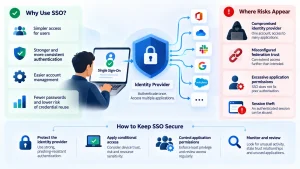
The strongest SSO environment keeps the convenience of centralised authentication without allowing one identity, trust relationship or session to become an unrestricted route across the business.
Review SSO and Federation as the Application Environment Changes
SSO environments rarely remain static.
New SaaS platforms arrive, employees change roles, administrators add integrations and older applications gradually disappear. Mergers and acquisitions can introduce additional identity providers, directories and federation relationships that were designed under entirely different security assumptions.
Regular review should identify applications that still use local passwords, unused federation connections, stale assignments and administrator roles that no longer reflect business need.
Hybrid environments deserve particular attention. Where on-premises identity systems synchronise or federate with cloud services, weaknesses can cross the boundary between them. Active Directory and Identity VAPT can help reveal unsafe delegation, excessive permissions and trust relationships that make identity compromise more damaging.
Organisations should also test failure scenarios. If the main identity provider becomes unavailable, teams need a secure recovery path that preserves access to essential administration without creating a permanent authentication bypass.
Aegixis Identity & Endpoint Security Services can support organisations that need to strengthen central authentication, privileged access, least privilege and endpoint security around an expanding identity environment.
Final Thoughts
SSO becomes valuable when it removes weak, scattered authentication without replacing it with one poorly protected central identity. Done well, federation gives businesses stronger authentication consistency, simpler account lifecycle management and better control over how users reach connected applications.
The security test is what an attacker gains after compromising that central identity. Strong authentication should make takeover difficult, least privilege should restrict what successful access can reach, trusted endpoints should protect active sessions, and well-managed federation should prevent applications from trusting more than they should. Centralise the login, not the risk.