A business account can provide access to much more than a single application. Employees may use one identity to reach email, collaboration platforms, cloud services, customer data and internal systems, while privileged users can control infrastructure, security settings and other high-impact resources.
Attackers therefore have a strong incentive to obtain legitimate user access. They may steal passwords, manipulate authentication processes, hijack existing sessions or exploit weak account recovery rather than attempting to break directly through every technical defence.
Identity security protects accounts across this wider attack surface. It combines strong authentication with controlled privileges, secure account lifecycle management, monitoring and effective response so that one compromised credential does not automatically become a wider business incident.
This approach also connects closely with the wider relationship between identity and endpoint security. User identities operate through endpoints, which means a well-protected account can still face risk when the device carrying its authenticated session becomes compromised.
How Attackers Compromise Business User Accounts
Attackers can target several parts of the identity lifecycle. A strong password may stop one method while leaving phishing, session theft or account recovery exposed through another route.
Understanding those attack paths helps businesses protect accounts based on how compromise actually happens rather than focusing solely on password complexity.
1. Phishing Steals Access Through the User
Phishing allows attackers to target the employee instead of technically defeating the authentication platform.
A fraudulent email might imitate a Microsoft 365 notification, shared document request or security warning. When the employee enters credentials into a fake login page, the attacker obtains information they can try against the legitimate service.
MFA significantly reduces the usefulness of a stolen password, but attackers continue to adapt. Some phishing techniques attempt to capture one-time codes, manipulate approval prompts or intercept authenticated sessions.
Email security therefore plays an important role alongside identity protection. An email security assessment can identify weaknesses in domain protection, mailbox configuration and anti-phishing controls that increase the likelihood of identity attacks reaching employees.
Strong authentication still matters after those protections fail. The objective should be to make a successful phishing interaction only the beginning of the attack rather than enough to take over the account immediately.
2. Password Reuse Turns External Breaches into Business Risk
A password does not need to leak directly from the business to create risk.
Employees often maintain personal and professional accounts across many services. Reusing credentials means compromise of an unrelated platform can provide attackers with combinations worth testing against corporate systems.
Automated credential-stuffing attempts make this problem more scalable. Attackers can test large sets of previously exposed usernames and passwords without needing to target each employee individually.
Businesses should therefore encourage password managers, block weak or known-compromised passwords where practical and use MFA so that possession of a password alone does not provide immediate access.
The NCSC identity and access management guidance also emphasises controls that go beyond passwords, including authentication, access management and appropriate privilege.
3. Session Theft Can Bypass the Need to Log In Again
Authentication normally creates a session so users do not need to enter credentials every time they open another page or perform another action. That improves usability, but the authenticated session becomes another asset attackers may try to steal.
Malware running on an endpoint can attempt to obtain browser data, tokens or other authentication material associated with an active user session. Depending on the application and environment, the attacker may then gain opportunities without reproducing the original login.
Consider an employee who successfully completes MFA from a laptop that malware already controls. The authentication mechanism works correctly, but the compromised device creates another route to the account after login.
Endpoint protection therefore supports identity protection. Businesses that want to understand this relationship in more detail should consider how identity and endpoint security work together rather than evaluating authentication and device security as separate controls.
An endpoint security assessment can also reveal practical weaknesses such as credential exposure, excessive local privileges and inadequate endpoint protection that could increase the value of session theft.
4. Weak Account Recovery Can Undermine Strong Authentication
Attackers naturally look for whichever identity process offers the least resistance.
A company may enforce strong MFA for normal access but allow users to reset an account through a weaker recovery process. Social engineering can create another opportunity when attackers impersonate employees and ask helpdesk staff to reset passwords or replace authentication methods.
Recovery processes therefore need enough assurance to prevent attackers from bypassing the controls protecting ordinary login.
The current NIST Digital Identity Guidelines treat authentication, authenticator management and related identity processes as connected parts of digital identity rather than isolated controls.
Businesses should review who can initiate recovery, how the organisation verifies that person and what happens when someone replaces an authenticator. High-risk accounts deserve particularly careful recovery procedures because attackers gain more from successfully resetting them.
Account compromise usually develops through several stages rather than one isolated failure. The diagram below shows how attackers move from targeting an identity to expanding access, and where layered security controls can interrupt that progression.
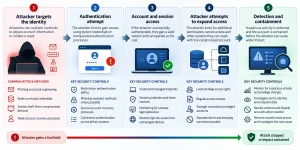
How Identity Security Protects User Accounts from Compromise
Effective identity security should make account takeover harder while also reducing the damage if attackers still succeed.
That requires several controls to work together. Authentication limits entry, privilege management restricts what the account can reach, lifecycle processes remove stale access and endpoint controls protect the environment in which the user operates.
1. Use Strong Authentication Based on Account Risk
MFA should protect important business accounts because passwords remain vulnerable to phishing, reuse and theft.
Organisations should also consider the strength of the authentication method rather than treating all MFA as equivalent. Accounts that can administer infrastructure, approve payments or access sensitive information justify stronger protection than routine low-risk access.
Authentication coverage matters just as much as method strength. A business may protect Microsoft 365 thoroughly while leaving a legacy VPN, remote management interface or older application accessible with a password alone.
Attackers will usually favour the weaker route.
Strong identity security therefore looks for gaps across all important access paths rather than measuring success by the percentage of accounts enrolled in one authentication platform.
2. Apply Least Privilege Before Compromise Happens
Authentication determines whether the organisation should accept the identity. Authorisation determines what that identity can do afterwards.
Least privilege limits accounts to the access users genuinely require for their role. This control becomes particularly important when attackers manage to bypass or steal authentication.
Imagine an employee who transferred from finance to operations. Their account receives new permissions for the operations role, but nobody removes the old finance access.
The employee may never misuse those permissions, yet an attacker who compromises the identity inherits both sets of privileges.
Regular access reviews help remove these unnecessary permissions before compromise occurs. They also make it easier to identify users whose access no longer matches their actual responsibilities.
The NCSC Cyber Assessment Framework guidance on identity and access control supports limiting access according to business need and reviewing permissions as circumstances change.
3. Manage Accounts Through the Full User Lifecycle
Identity risk often grows because access management fails to keep pace with organisational change.
New employees need accounts, existing staff move between teams, contractors join projects and users eventually leave. Every transition should trigger an appropriate identity decision rather than simply adding more access over time.
Joiner processes should establish only the permissions the user requires. Role changes should review existing access before granting new permissions, while leaver processes need to disable accounts and revoke relevant access promptly.
Temporary identities deserve the same discipline. Contractor accounts, project users and testing identities should have clear owners and expiry conditions instead of remaining active indefinitely.
A broader identity and endpoint security posture assessment can help expose stale accounts, unmanaged devices, inconsistent MFA and excessive privileges that individual product dashboards may not reveal.
4. Consider Device Trust as Part of Account Protection
A legitimate account does not guarantee that the device using it is safe.
Employees may authenticate from unmanaged personal devices, outdated corporate laptops or endpoints where protection tools have stopped functioning. If the account can access sensitive resources regardless of endpoint condition, identity assurance tells only part of the security story.
Businesses can strengthen high-risk access by considering device trust alongside identity. For example, routine collaboration tools may permit more flexible access, while financial or administrative systems could require a managed endpoint that meets defined security requirements.
This principle forms a central part of Zero Trust endpoint security, where access depends on the relationship between the identity, endpoint and requested resource rather than one successful login.
Device trust should remain proportionate to risk. The objective is not to block every unfamiliar device automatically, but to prevent high-value access from relying solely on valid credentials.
Protect Privileged Accounts More Aggressively
Privileged identities require additional protection because attackers can use their legitimate permissions to create much greater impact.
System administrators, cloud administrators and other high-access users may change infrastructure, alter security settings or reach sensitive information. Compromise of one privileged identity can therefore create opportunities far beyond the original account.
Businesses should separate everyday activity from privileged administration where practical. Administrators should use ordinary identities for email, browsing and routine collaboration rather than exposing powerful accounts to unnecessary activity.
Standing privilege also deserves review. When administrators need elevated access only occasionally, controlled or time-limited elevation can reduce exposure compared with keeping those permissions available continuously.
The endpoint used for privileged work matters as well. A high-value identity operating from a heavily exposed workstation creates a larger attack surface than the same account restricted to a more tightly controlled management device.
Microsoft environments can add another layer of complexity through nested groups, delegation and other privilege relationships. Active Directory and Identity VAPT can identify escalation paths and unsafe permissions that could allow attackers to turn one compromised identity into much broader control.
Aegixis Identity & Endpoint Security Services can support businesses that need to strengthen privileged access, least privilege, endpoint hardening and account security as connected controls rather than separate projects.
Detect Account Compromise Before Attackers Expand Their Access
Even strong preventative controls cannot guarantee that every account takeover attempt will fail. Businesses also need enough visibility to recognise when legitimate-looking access starts behaving abnormally.
Identity monitoring can reveal suspicious authentication attempts, repeated MFA failures, unexpected password resets, new authentication methods and unusual privilege changes. None of those events automatically proves compromise, so context matters.
A login from an unfamiliar location might reflect normal travel. If the same identity then registers a new authentication factor, accesses unusual resources and changes security settings, the combined sequence deserves far greater attention.
Endpoint telemetry can add another layer of evidence. EDR may detect credential-access behaviour, malicious browser activity or suspicious script execution on the same device associated with the identity.
Connecting those signals helps defenders see the full incident rather than separate alerts.
Security teams should also establish a clear containment process. Once compromise appears likely, responders may need to terminate sessions, revoke tokens, reset credentials, remove unauthorised authentication methods or disable the account temporarily.
The investigation should then determine what the attacker accessed and changed. Resetting a password does not reverse privilege modifications, mailbox rules, downloaded information or persistence that attackers may have established before detection.
Review Identity Security Through Real Attack Paths
Identity controls often look stronger when reviewed individually than when attackers combine them.
A company might enforce MFA, maintain an account lifecycle process and use EDR across corporate endpoints. Yet one forgotten legacy application could still accept password-only authentication, or a privileged account might retain access from an unmanaged device.
Reviewing real attack paths helps expose these gaps.
Ask what happens if an attacker steals an employee password. Does MFA stop them? Could another application bypass that protection? What would the identity reach if the attacker successfully gained access?
Then consider endpoint compromise. Could malware steal authenticated sessions? Does the user have permanent local administrator rights? Would the account provide access to sensitive systems that the employee no longer needs?
Finally, test recovery and containment. Can someone impersonate a user to reset MFA? Can administrators revoke active sessions quickly? Would security teams know which devices and applications the compromised identity had accessed?
These questions reveal whether identity security works as a connected system rather than a collection of independently configured products.
Final Thoughts
Identity security becomes stronger when organisations stop treating the password as the main boundary around a user account. Attackers can target authentication, sessions, recovery processes, privileges and endpoints, so businesses need controls that cover the entire path from login to authorised activity.
The practical goal is to make compromised accounts difficult to obtain and deliberately limited when attackers do obtain them. Strong authentication reduces entry opportunities, least privilege constrains the account, trusted endpoints protect active access, and monitoring gives defenders a chance to respond before one identity becomes a much larger security problem.